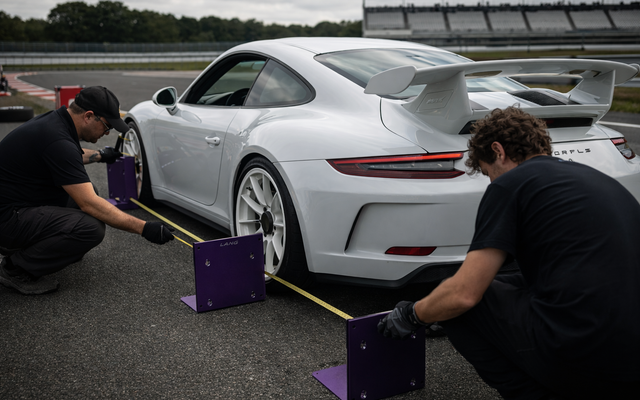
In the intensely competitive world of contemporary professional oversteer competition, podium finishes is far more than purely a result of brute torque or driver aggression. Instead, it is now a multifaceted discipline which necessitates a painstaking blend of picking a proven vehicle platform, outfitting it with the correct performance parts, and, most critically, comprehending its real-time behavior on the track through cutting-edge drift telemetry software. This exhaustive guide functions as your roadmap from the very first concept of a project car right through to the final data-informed adjustments that turn a strong car into a predictable champion. We will thoroughly explore the precise engineering of vehicle alignment optimization, illustrating how a modern drift tuning app like precise measurement hardware removes guesswork and offers exceptional visibility into your car's true behavior.
The bedrock of any great drift car is, indisputably, the chassis itself. Several cars have attained legendary standing within the international oversteer scene due to their inherent weight distribution, durable build quality, and the enormous availability of performance parts available. Picking the right car is the initial and most important choice a builder will make. As an example, the BMW E36 is widely regarded as perhaps the the greatest all-around cars for drifting of the modern era. Its almost ideal evenly distributed mass, alongside a rear-wheel-drive layout and extremely reliable six-cylinder powerplants, creates a car that is simultaneously forgiving for novices and highly effective in the control of a pro driver. The next step of this lineage, the BMW E46 platform, refines these qualities with a more refined frame, broader wheel track for enhanced high-speed stability, and even increased lock as standard from the manufacturer. A different dominant contender in the pro scene is the Chevrolet Corvette C6.
This American sports car brings a unique combination of advantages to the sliding world, including a low-mass aluminum structure, a rear-mounted gearbox and differential unit that aids in an excellent balance, and the colossal low-end power of a big GM LS engine. This blend transforms it into an complete weapon on track, designed of initiating and holding long drifts with seemingly effortless application of throttle. For builders looking for remarkable bang-for-the-buck, the Nissan Z33 excels as a excellent example. It comes from the manufacturer with a robust platform, a competent OEM limited-slip differential, and the free-revving VQ series engine that delivers ample horsepower and torque for practicing and progressing in the sport. Its successor, the Nissan 370Z, presents further advancements in body strength, suspension design, and overall engine power, solidifying its status as a common choice among competitive pilots. Other iconic cars that merit attention encompass the nimble rotary-powered FC generation RX-7, the ubiquitous Nissan S13, the torque-rich Ford Mustang SN95, the more recent BMW E90, and the compact yet incredibly fun and teachable MX-5 Miata. All of these platforms provides a unique palette of attributes, complexities, and possibilities, but they all have in common the core ingredients necessary to be transformed into a capable sliding vehicle.
However, selecting the right chassis is merely the first step. To unlock the true capability of any of these cars, major upgrades to the steering and chassis control systems are completely essential. This is where the realm of performance aftermarket hardware becomes vital focus. The one most impactful upgrade for a dedicated drift car is the installation of a maximum-angle angle modification kit. These advanced systems, for example those developed by performance brands like SLR Speed, are engineered to significantly increase the vehicle's maximum steering angle. A standard production vehicle is highly restricted in how far its steering tires can turn, a design limitation for public road use. In oversteer driving, however, extreme steering input is frequently needed to manage and hold a drift. An steering kit replaces the factory steering knuckles, tie rods, and sometimes A-arms with pieces that enable the wheels to attain steering lock beyond 70 or even 80 degs, compared to a typical stock setting of around 40 to 50 degrees.
This tremendously greater lock provides the operator with significantly more authority during a slide, making it considerably simpler to initiate a oversteer moment, maintain it through a long bend, and transition fluidly from one angle to the opposite. The difference in drivability is nothing short of profound. Paired with a correctly selected steering kit is the equally vital upgrade to the chassis's suspension. Generic or even expensive road coilovers are just not intended for the unique and harsh needs of sliding. A drift-spec set of adjustable dampers is of utmost importance. These specific suspension components feature specific piston tuning and spring rates that are tuned for the extreme weight transfer that is characteristic of sliding. When a operator initiates a drift, the car's inertia is shifted forcefully to the outside of the turn. Correct competition suspension handle this transfer in a predictable manner, enabling the car to stabilize promptly and offering the operator accurate feedback through the steering wheel and seat. They also allow for precise adjustment of ride height, rebound and compression firmness, and weight balance, which are all fundamental elements of optimizing the chassis's behavior to a particular circuit or piloting technique. In combination, a precision-engineered angle modification system and a correctly selected set of drift-spec coilovers form the core hardware cornerstone upon which all future optimization is constructed.
Once the fundamental hardware is installed, the next vital step in the project is the meticulous adjustment of the vehicle's suspension geometry. This is the realm of car suspension tuning, a procedure that can appear intimidating to the uninitiated but is, in fact, the key to converting a collection of high-performance pieces into a unified and predictable vehicle. The most critical aspect of suspension geometry for drifting is certainly negative camber. Camber is the angle of the tire relative to the perfectly straight line when viewed from the front-on of the chassis. If the upper part of the tire is angled inward, this is known as negative camber. For drifting, negative camber on the front axle tires is generally applied and is seen as critical. The purpose is deeply linked to physics.
When a chassis is cornering at high slip angles, the body rolls toward the outer of the corner. This chassis roll makes the outer front wheel to diminish its ideal footprint with the track surface. By adding an inward tilt, the tire is pre-tilted to compensate for this lean. As the vehicle rolls into the turn, the tire gains a better contact patch against the road surface, increasing its traction at the precise point when it is needed most for steering authority. Commonly, front axle camber settings for a dedicated sliding vehicle fall between approximately -3 degrees to as extreme as -5 degrees or even beyond, contingent on the details of the chassis configuration, tire type, and driver style. The back wheels also utilize negative camber, but the angles are usually more modest and less aggressive than the front axle. Too much negative camber at the back can result in the chassis overly tail-happy and challenging to predict on acceleration input, as it reduces the usable tire footprint of the driven tires during linear acceleration. Thus, rear axle adjustments are commonly in the vicinity of -1 degree to -3 degrees, achieving a careful compromise between giving enough cornering grip to aid in initiating and sustaining the slide while still maintaining effective grip for power-down the bend. alignment is only one component of the larger tuning picture, which furthermore includes toe, caster, and suspension-induced steering correction.
Toe describes the orientation of the tires when looked at from above. Inward toe means the leading edges of the wheels are closer together than the trailing edges, while toe-out means the reverse. For drifting, a modest amount of front negative toe is commonly run to improve the turn-in handling reaction, making the car feel more agile and eager to start a oversteer moment. Rear axle toe is typically set to neutral or a incredibly small amount of toe-in to encourage predictability under acceleration. Caster is the forward or rearward inclination of the kingpin axis when viewed from the side of the chassis. Increased positive caster enhances feedback and high-speed stability, and it also boosts inward lean effect during turning, which is extremely useful. Tuning these values is a intricate interaction where a modification to one parameter can and often will affect the remaining parameters. The traditional process for dialing in a car's suspension geometry for drifting has long been a labor-intensive process of experimentation and feeling. A driver or crew would make a adjustment based on intuition, run the car on track, rely on the pilot's individual feel and feedback, and then apply a further adjustment. This process would repeat over and over until the chassis felt "good" or the available practice time ended. This methodology is not just exceptionally wasteful in terms of man-hours and tires, fuel, and parts, but it is furthermore deeply flawed.
Driver feel is a infamously unreliable data source, colored by numerous variables such as exhaustion, evolving track surfaces, ambient heat, and just the mindset of the pilot on that specific run. What feels "loose" on one run might feel "tight" on the following pass, causing contradictory data and counterproductive adjustments. This traditional limitation in car suspension tuning is specifically where contemporary technology has intervened to revolutionize the methodology.
The rise and application of specialized vehicle dynamics tools has ushered in a completely new age for engineering and refining high-performance sliding vehicles. This new generation of platforms, showcased by cutting-edge systems like data acquisition tools, work by physically measuring the suspension engineering real-time physical performance of the chassis as it is being driven on the track. Unlike relying on personal impression, these systems gather objective information on essential factors such as suspension travel, corner velocities, G-force loading, wheel angle, and accelerator and brake pedal application. This collected telemetry is then processed by sophisticated software that can graph and interpret the information in a clear way. For the first time, drivers and teams can visualize precisely what the vehicle is performing at every millisecond of a lap. This function transforms the whole chassis setup workflow. Imagine the specific task of setting the front negative camber for a specific chassis. Instead of making a change from -3 degrees to -3.5 degrees and then testing several runs to try and "feel" a improvement, a vehicle dynamics tool can provide immediate and irrefutable information. The tool can display graphically how the wheel's grip is performing during the most important phases of a angle: the initial flick, holding the angle, and transition. It can show if the current camber setting is permitting the loaded tire to achieve optimal contact or if the compound is over-stressed on its external edge.
The software can subsequently suggest empirical suggestions for adjustment. Perhaps the telemetry shows that the outside front tire is still stressing its sidewall at -3.5 degrees of negative camber, indicating that even more negative camber, say -4 degrees, might be warranted. On the other hand, the information might show that the tire is not coming up to optimal operating temp or that the inner edge is wearing too quickly, which could suggest that there is excessive angle and a modest reduction back to -3.2 degrees drift suspension tuning guide would be more ideal. This standard of accuracy and practical intelligence was completely unattainable in the time of solely seat-of-the-pants setup.
The benefit of utilizing a dedicated suspension tuning tool reaches far beyond only optimizing camber angles. It becomes an priceless damper adjustment manual that is tailored to your specific car. When fine-tuning the shock absorber settings on your coilovers, instead of depending on vague tips or replicating another driver's settings, you can employ the telemetry to observe how the car is performing in response to your changes. The tool can graph the suspension travel path over a run, highlighting if the dampers are controlling the body movement properly or if they are permitting the vehicle to bounce excessively after a direction change. It can assist in identifying challenges like excessive compression or topping out, permitting you to apply informed decisions to spring preload, rebound/compression values, or ground clearance. This approach extends similarly to the detailed art of corner balancing. Beyond camber, the tool can give insight into how changes to toe settings and caster angle are impacting the vehicle's handling during specific phases of a slide. For instance, it can assist you to determine the drift angle kits ideal amount of front toe out for your individual steering rack setup and driving style by measuring the quickness of initial response and the predictability of the chassis at full lock. This transforms the software an exceptionally effective performance optimization handbook that is constantly informed by the live behavior of your personal chassis on the track. It shifts the entire project from a dark art into a repeatable optimization exercise.
Additionally, the application of a tool like data acquisition is in no way restricted to experienced engineers with extensive funding. For the amateur driver, it functions as an incredible educational tool. It practically provides the tuner with the analysis of a professional suspension specialist without the corresponding overhead. It speeds up the learning curve by delivering unambiguous solutions to challenges that would traditionally take countless track days of trial and error to solve. A driver can understand how their specific chassis responds to various settings, building a more profound understanding of vehicle dynamics in the journey. It additionally opens up high-level performance tuning concepts, allowing all drivers with the ambition to refine their car to achieve it in a efficient and productive way. This is notably significant in a activity like oversteer competition, where setup knowledge has traditionally been a tightly held advantage among professional drivers. In the modern era, that power can be in the toolkit of any dedicated driver.
In summary, the path to constructing and optimizing the ideal competitive drift car is a multi-faceted project that perfectly blends time-honored hardware wisdom with revolutionary data tools. It commences with the informed pick of a legendary car, then built upon the installation of critical performance components like maximum-angle drift angle kits and properly selected performance suspension units. The journey then progresses into the detailed stage of car suspension tuning, where values like camber angle, toe, and caster angle are precisely set to match the vehicle's upgraded geometry and the pilot's specific style. The final step, and what genuinely separates the today's methodology from the past, is the use of a advanced drift telemetry software. This platform removes the guesswork and waste of purely seat-of-the-pants setup by providing empirical, real-time information on how the vehicle is really behaving. It functions as an unparalleled suspension tuning tool, a definitive drift suspension tuning guide, and a all-in-one chassis development system. In unison, this complete methodology leads to that all component of the drift machine—from the selection of the platform to the final adjustment on the suspension—is optimized for ultimate performance on the circuit. It embodies the full maturation of the sport of sliding, connecting raw driving skill with surgical vehicle setup to create the ultimate dominant vehicles possible.